On Tuesday, June 9th, we went to the Design Museum in Holon. It was an amazing museum!!! Probably one of the best museums I have ever been to, and that is saying a lot, especially since I don’t normally like museums.
The Design Museum is 10 years old, and for the 10th anniversary of the museum there was a new exhibit. The new exhibit was called the State of Extremes. There were four sections: Polarization, Extremer, New Normals, and Spiralling.
There were tons of displays that I loved, but I am only going to share some of them. One of my favourite displays was about ceramics being shaped to look like coral and then being placed in the Red Sea (as a test) to try and help with the dying coral problem. Apparently, when the ceramic ‘coral’ is put underwater, other creatures lay their eggs there and live off of it, and other real coral attaches itself to it and grows.
There were a few other displays that I found interesting. I learned a lot from photos taken to expose, “the social and economic dividing lines inscribed in the physical landscapes of the world’s most unequal societies,” (this quote is from an explanatory sign in the museum), maps displaying gerrymandering in the US (gerrymandering is when voting district lines are redrawn around certain groups of people so that one political party gets an unfair advantage). I found an exhibit about Siri Zen Master weird but cool. That exhibit was about a blend between technology and spirituality. There was also an interactive exhibit (that was closed due to COVID) about voting separately for various issues instead of voting for one party, a display about a ‘Bleached Coral Collection’ where a bunch of objects and clothing are painted white (bleached coral) to try and bring awareness to the fact that coral is dying on a global scale, and individualised designed sushi that is made to fulfil your nutritional needs.
Another exhibit that I liked was called (Im)possible Baby. It was about how in a few years lesbian couples will be able to get pregnant without sperm, and have kids (only girls because there won’t be any Y chromosomes) that are genetically related to both of them. I don’t remember all of the details, so if you want, you can search (Im)possible Baby on the internet and learn more.
I am not going to mention everything I liked in the museum, because that would take way too long (and I am too lazy for that), so if you want to know more about the museum, when you are next in Israel, go see for yourself!
This museum was fantastic, but it was not about any light topics. It explored what the future might look like, prejudices, and climate change.
-Naomi

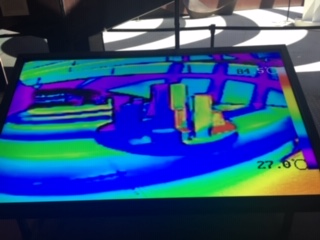
A screen in the entrance to the museum showing the temperature of all the areas of the room
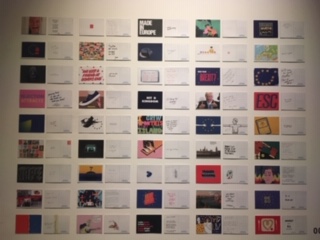
Postcards written from people in the UK to friends, family, and colleagues in countries of the EU in the wake of the Brexit vote in 2016
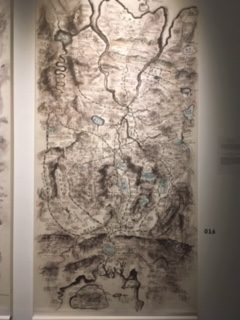
A map of social relationships (which is part of a series of hundreds of maps)
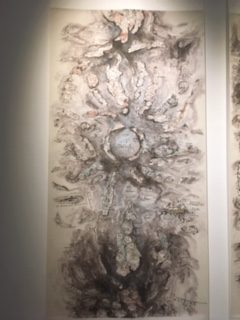
A map of human emotions (which is part of a series of hundreds of maps). This and the above photo are made by the same artist
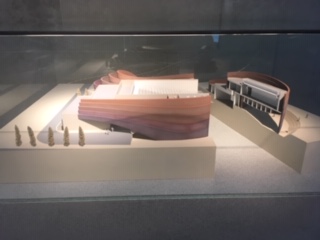
This is a model of the museum. It is a strange building, but I think it is cool
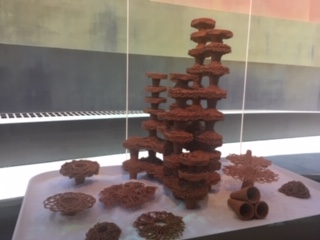
Ceramic coral
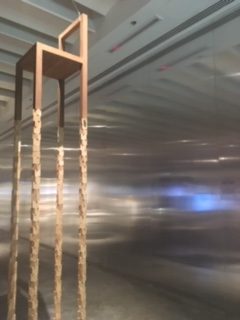
A chair that keeps being raised so that it doesn’t sink underwater while the oceans rise
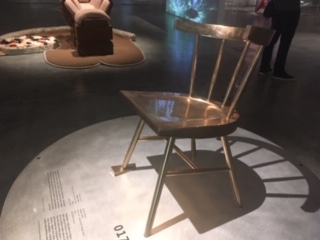
A chair that is starting to sink (because waters are rising)
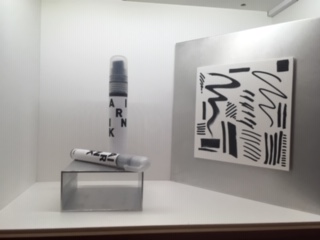
AIR-INK is an ink made from air pollution. “One 30 ml. AIR-INK marker is equivalent to 45 minutes of car pollution.” (This fact was on a sign in the museum)
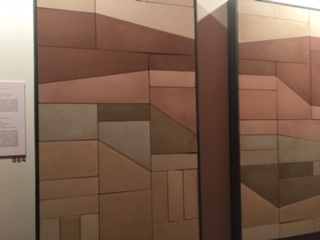
This is Criaterra. It is a material that can be used for architectural construction that is as strong as concrete, but with a much smaller ecological footprint
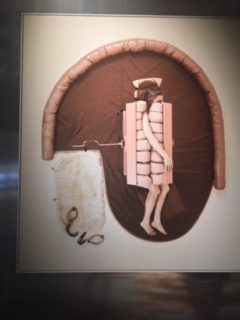
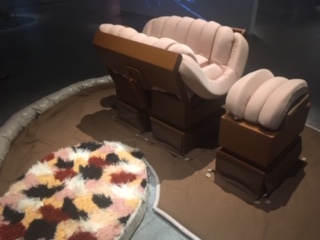
This was called a Compression Cradle, but I call it a cuddle machine. This machine squeezes users, and could be substitute for human touch, if needed