Today, I went back to Hevron. This time with Pardes. I wasn’t planning to go back to Hevron, but can’t pass up a good tiyul and was interested to see how Pardes would present Hevron with its breadth of political positions amongst students and faculty. Pardes has paired the trip with a panel tomorrow with four faculty members on their feelings on the sentiments. And while, they did not work with breaking the silence, they have been allowing students to advertise another trip to Hevron with breaking the silence.
Pardes attempted to explore Hevron from both a historical perspective and a political perspective. And I will too in this blog post.
We learnt about the history and architecture of the religious site called the cave of the machpela, a site mentioned in this week’s torah portion as the burial site bought by Abraham to bury Sarah, and also the burial site of Abraham (by his two sons Isaac and Ishmael), Isaac and Rebecca, Jacob and Leah (Rachel is buried outside Bethlehem). Much of the exterior of the current building comes from Herod the great (1st c bce) and has a similar structure to what likely was the second temple and the temple mount. The current space is strictly divided between Muslim and Jewish sections (with different entrances so the new groups never interact) as a result of a killing spree in march 1994 by settler Baruch Goldstein of Muslim worshippers. There are ten days a year, it is open only for Jewish worshippers, and ten days a year it is only open to Muslim worshipers and the rest of the year, both groups have access. Inside there are sections and raised tombs for each pair of patriachs/matriarchs and the main Jewish area is an open courtyard to the sky. There is no visible cave despite the name, though there were some settlers who removed some stones in the floor to a hidden stairs leading down and found a corridor and two caves when they stuck down there a couple decades ago one night over selichot services when the Muslim guard fell asleep.
Interestingly, unlike the western wall, the army has maintained control of the religious site of the cave of the machpela (maybe not surprising given the religious tensions) and not let any arm or affiliate of the rabbinate have any presence there so there is not the same limitations and rules in terms of dress and mixed davening as the kotel. And we actually had an incredibly beautiful egalitarian mincha led by a women inside the cave. And while I am not one to usually experience energies, there was a definite powerful energy in the space that our whole group felt. Something very intense about saying in the amidah “Elohei Avraham, Elohei Yitzhak, Elohei Yaakov, Elohei Sarah, Elohei Rivka, Elohei Leah” in the place where they are buried and calling out to their God to pay attention to us.

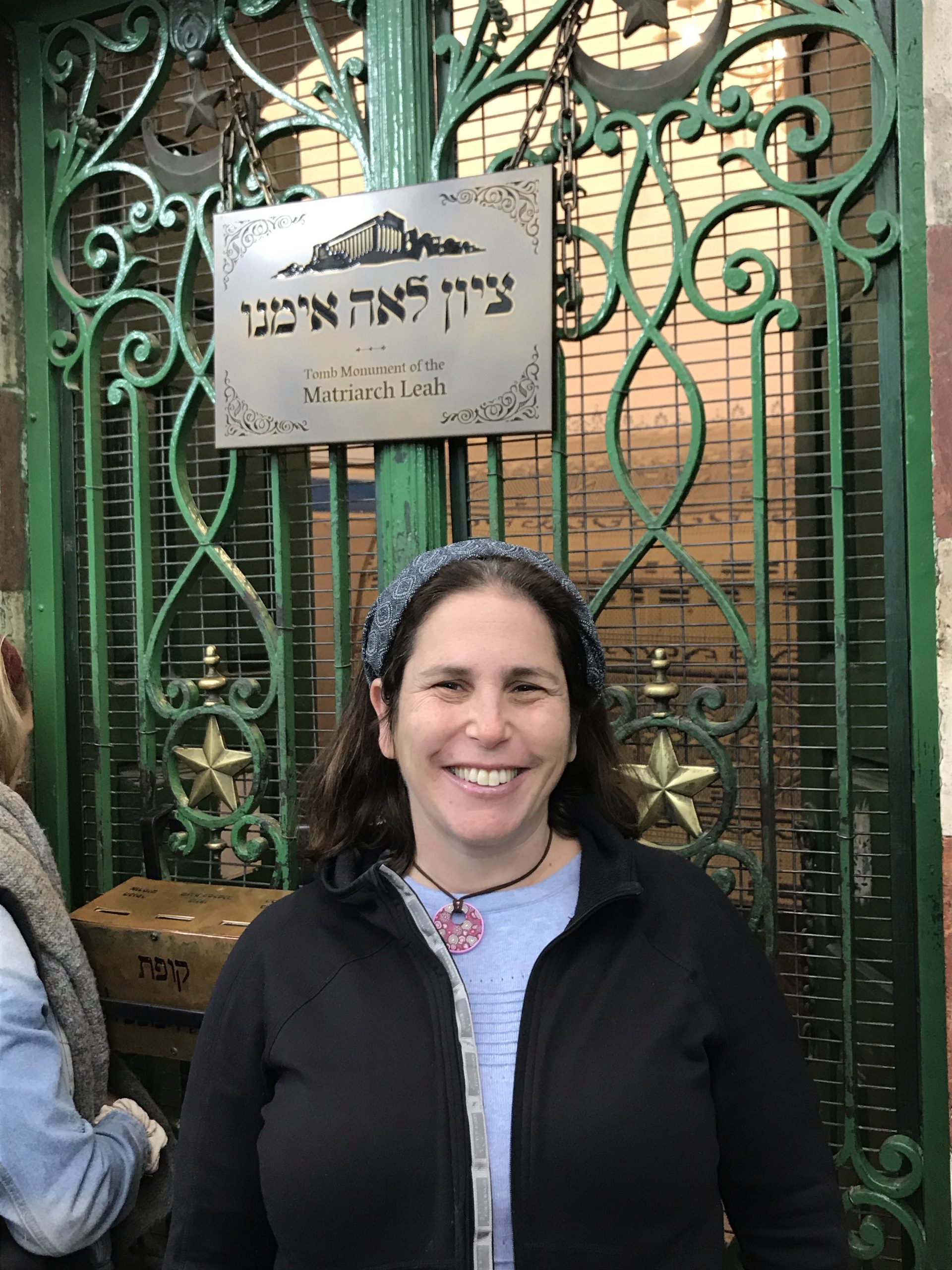
Me outside of Leah’s burial spot
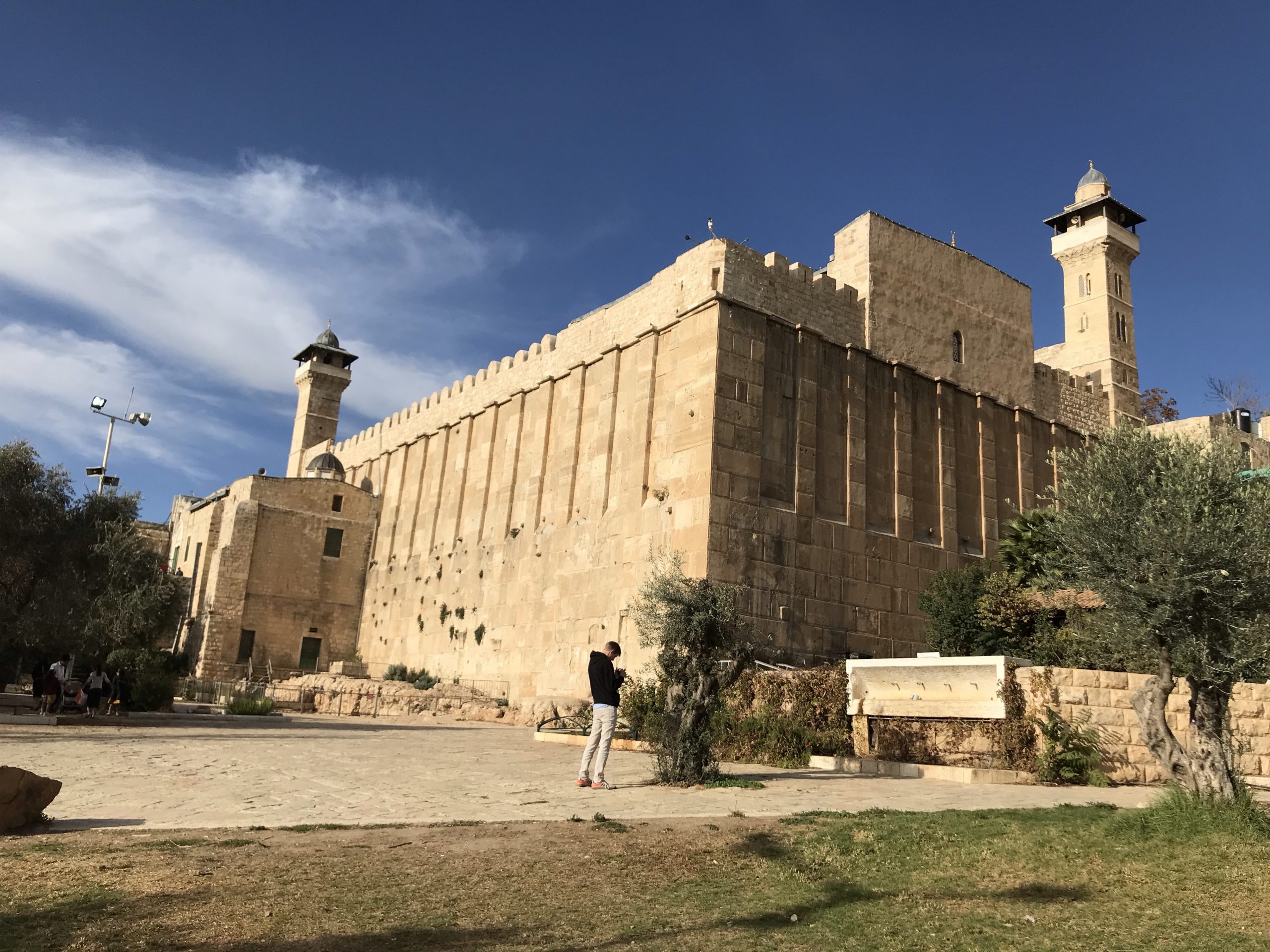
The cave of the majorly building
And with regards to the political, Pardes attempted to bring complexity and balance to the day with four guest speakers, from two very different political perspectives. We began our day with B’Tselem (an Israeli organization which tracks Israeli violations of human rights whose goal is to end the Israeli occupation). Then we met Noam Arnon, the official spokesperson for the Jewish community in Hevron, and longtime resident, inside a restored 500 year old synagogue called Avraham Avinu part of one of the Jewish settlement areas in Hevron. Then we met with local Palestinian activist with Youth Against Settlements (a Palestinian resistance group committed to non-violence) and lastly we visited a small settlement called Karmei Tzur (the one Jewish presence between the Etzion bloc of settlements and Kiryat Arba) to get the perspective of settlers in a small, isolated settlement. As you can imagine, everyone had very different perspectives on the conflict, on what is possible, on who is at fault and how to move forward.
Hevron is the only city where the Jewish settlements (they are in a few different guarded enclaves) is right in the middle of a Palestinian city. And since the 1994 massacre by Baruch Goldstein, the Israeli police have pursued protecting the settlers by limiting the movement of Palestinians through very restricted access (including no access to certain roads), and a serious of check points throughout the city that the Palestinians need to pass through and show their identity cards and they need to present themselves not by name, but by a number assigned to them by the army. Yes, Israel is assigning numbers to Palestinians and taking their name away from them – I just keep getting stuck on this reality and how we can do this. With the goal of limiting conflict, the Israeli government and army tries to keep settlers and Palestinians apart from one another. How do they do it? By limiting access of Palestinians to the roads near the Jewish enclaves which has some roads where Palestinians can’t drive, others where they can’t drive or operate their business and still others where they’re not allowed at all (including ambulances). From a moral perspective, I can’t stop being bothered by barring someone, not because they’ve done anything but simply because of their national identity.
We were supposed to meet our Palestinian host at the top of a particular hill – a location that both he and our group were allowed to visit. Our bus company surprised our group by saying the road was too steep and the bus would not be going to this location. Pardes follows a number of Israeli government recommendations and precautions including not being able to enter area a of the territories and only being able to travel on some of the roads today in a bullet proof bus, and not by public bus, or cab or walk. Why is this relevant? Because we were not allowed to reach our host by Pardes guidelines, and because of the areas blocked off to Palestinians, he was not legally allowed to come to where we were. Instead, he sent a friend who had greater access to more areas of Hevron (Palestinians get permission to enter different areas based on the location of their home). This new speaker was able to be on one corner, but not allowed to go farther and we were allowed (by Pardes and Masa security rules) to go close, but not up to the corner where he was. The whole way the conversation had to be orchestrated showed the challenges of Hevron. Beyond the standard narrative of the Palestinian plight and sharing about how they teach non-violent techniques, there were a few things that stood out. One, that he talked about the occupation going back 72 years that he is trying to end (yes, 1948(. Two, that it is clear his group also has run ins with Palestinian authority and its leader has been jailed by them and Israel. (he claims it is because they are anti-corruption). And three, he was aware of different american Jewish perspectives and pleased the group had been invited to speak at the J street conference and feels American Jews are starting to help his cause.
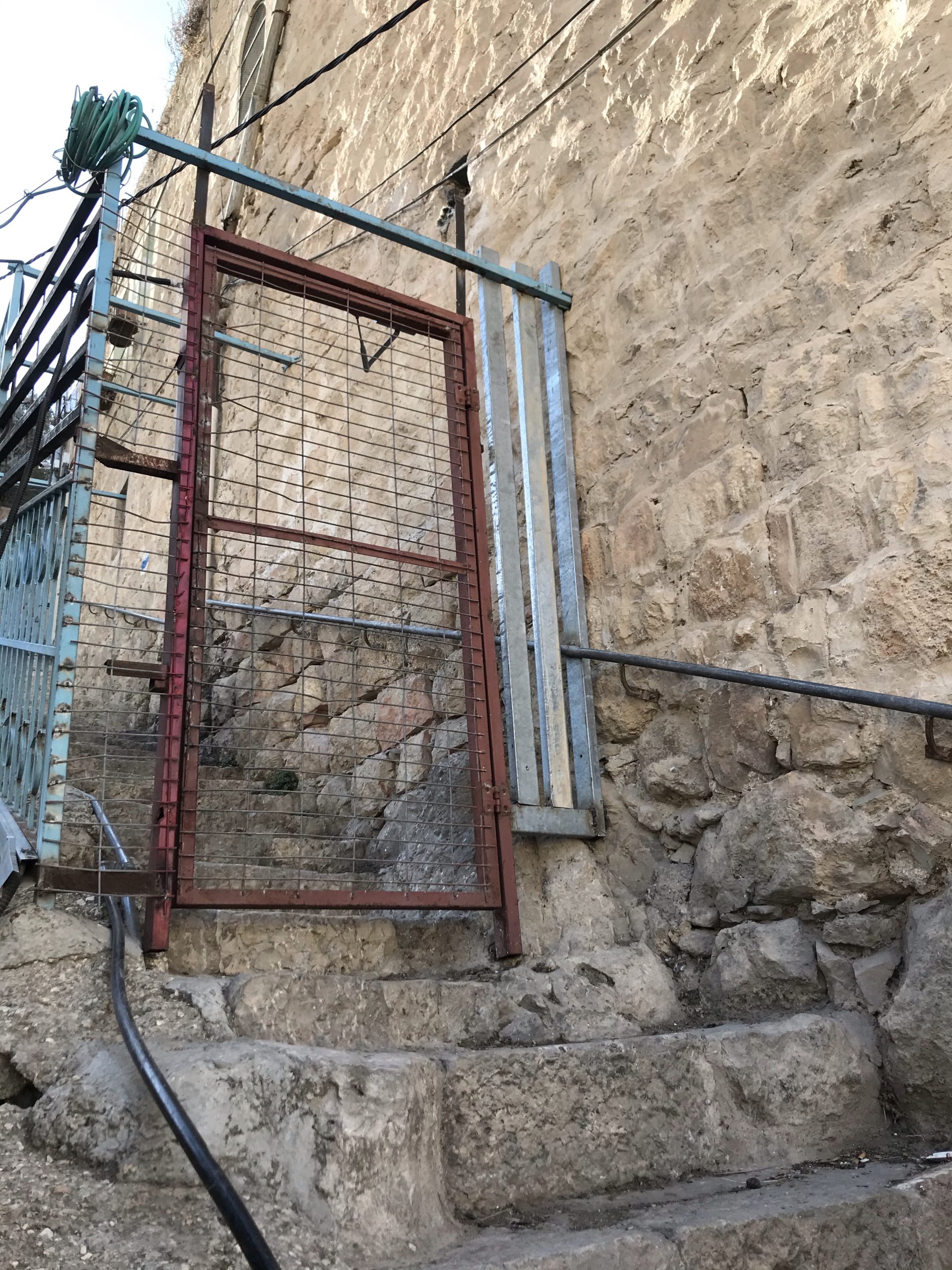
One of the many checkpoints throughout Hevron that Palestinians have to pass through to move within the city, to go to school, shop, go to work or move about
With regards to both Noam and our host at Karnei Tzur, we heard voices who loved and believed in where they were living and didn’t seem to be bothered by the political and logistic complexities (such as needing to bus your kids for school) of their homes. Neither seemed to have any current interaction with the local Palestinian population but recalled very positively when it used to be other and they shopped at the Palestinian stores and interacted. And we even heard that the muktar from the neighbor Palestinian town spoke and brought a gift at the official settlement dedication in 1984 and that the turning point was the first intifadah. They also didn’t seem worried about the demographic challenges of the large neighboring Palestinian communities nor their different legal status or the limitations they face.